Newly Observed Domains Feed
A continuous stream of every domain we see resolving for the first time. Block phishing infrastructure faster than threat-intel feeds catch up.
A continuous stream of every domain we see resolving for the first time. Block phishing infrastructure faster than threat-intel feeds catch up.
 Subscribe to the Feed
Domains, the moment they start resolving in DNS.
DNSArchive observes domain resolution continuously across the internet. The Newly Observed Domains feed is the firehose of every previously-unseen domain we record — usually within hours of first resolution, sometimes within minutes.
For security teams this is one of the most valuable signals you can have: ~95% of phishing and malware domains are registered, used, and abandoned within a few days. By the time a domain shows up on a commercial threat-intel feed, the campaign is often already over.
Our feed sees the domain when DNS does. That's the earliest possible point you can act on it.
How security teams use this feed.

Pipe new domains into your DNS resolver, secure web gateway, or email filter. Block first, allow on review — the right default for high-risk environments.

Run new domains through your enrichment pipeline (WHOIS, certificate transparency, hosting reputation) to surface high-confidence indicators within minutes of registration.

Match new domains against your own brand keywords. Combined with our Brand Protection feature, this happens automatically.

Pivot new domains by hosting IP, nameserver, or registrar pattern to map an entire campaign before it lights up.

Tag traffic in your SIEM where the destination domain is younger than X days. Strong heuristic for blocking unknown traffic in regulated environments.

Academics and security researchers use historical newly-observed-domain data to study attack patterns, registration abuse, and domain lifecycle.
The /latest page shows the most recent domains in the human-readable view — great for spot-checking and getting a feel for what the feed contains.
For programmatic access, the JSON API at my.dnsarchive.net/api/ exposes the same data
with pagination, time-window filtering, and per-domain metadata (NS, MX, observed IPs). Wire it into a
cron job, an enrichment Lambda, or a SOAR playbook.
Webhook delivery and S3 dump options are on the roadmap. If you have a specific consumption pattern in mind, email sales@noc.org.
View Plans
API docs
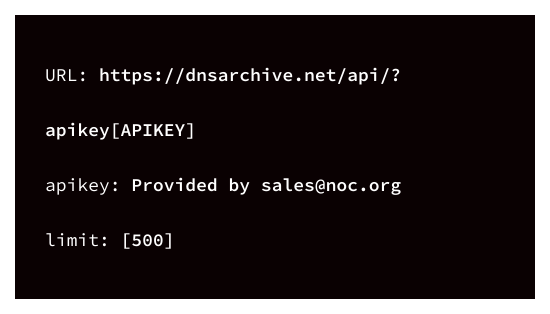
What you get back when you hit the API for newly observed domains:
{
  "domain": "example-new-domain.com",
  "first_observed": "2026-05-09T07:14:32Z",
  "ipv4": ["192.0.2.42"],
  "ns": ["ns1.somehoster.example.", "ns2.somehoster.example."],
  "mx": ["mail.example-new-domain.com."]
}
Each record represents a domain at the moment of first observation. The IP, NS, and MX values are what we saw at that moment — later changes are tracked separately and queryable through the historical DNS endpoints.
 Get API Access
 View Plans